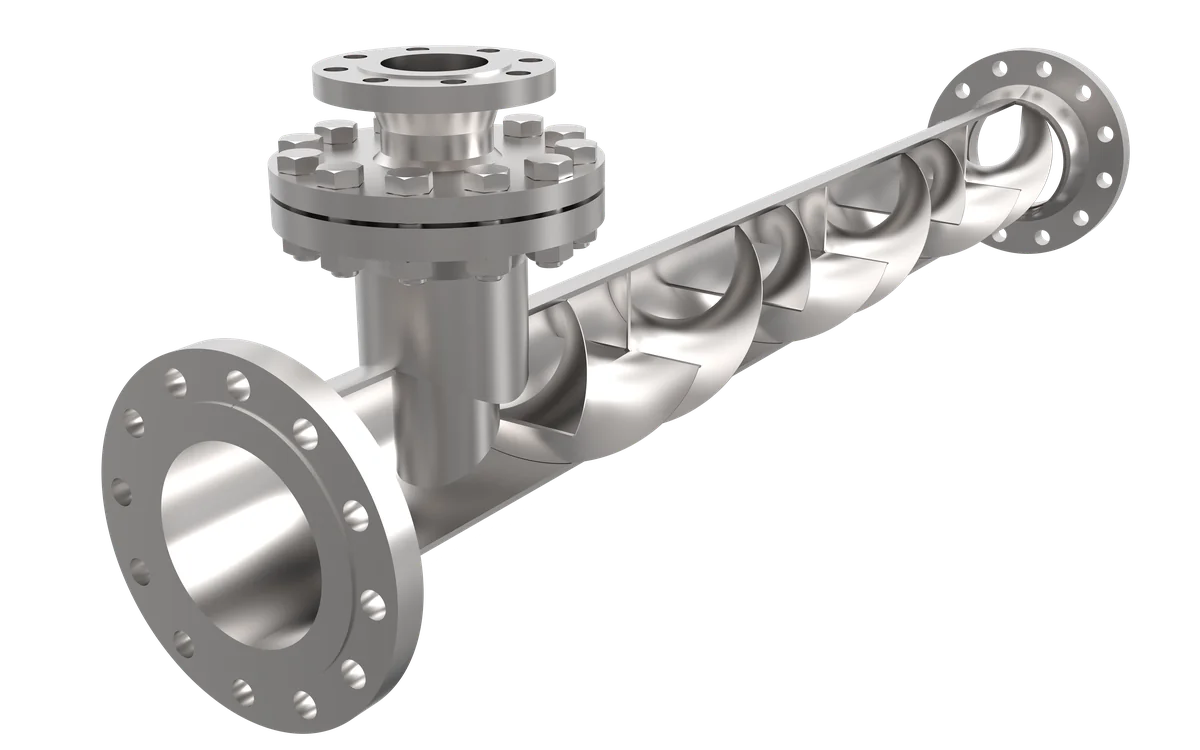
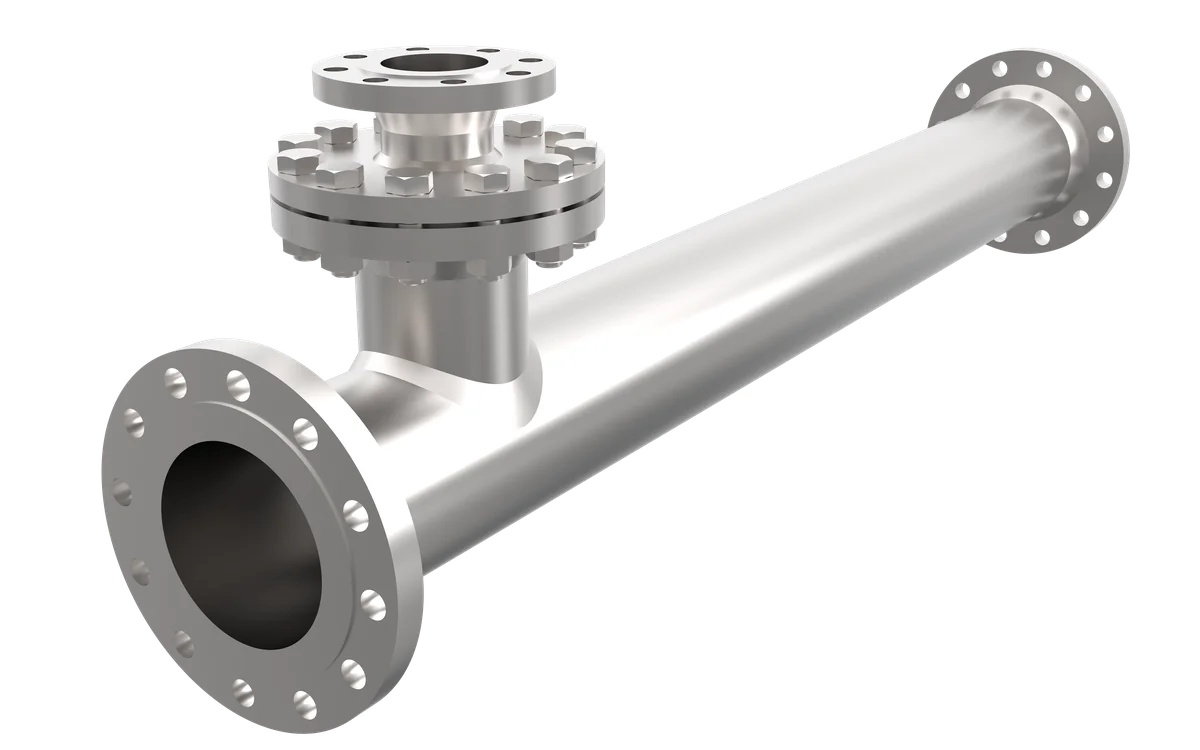
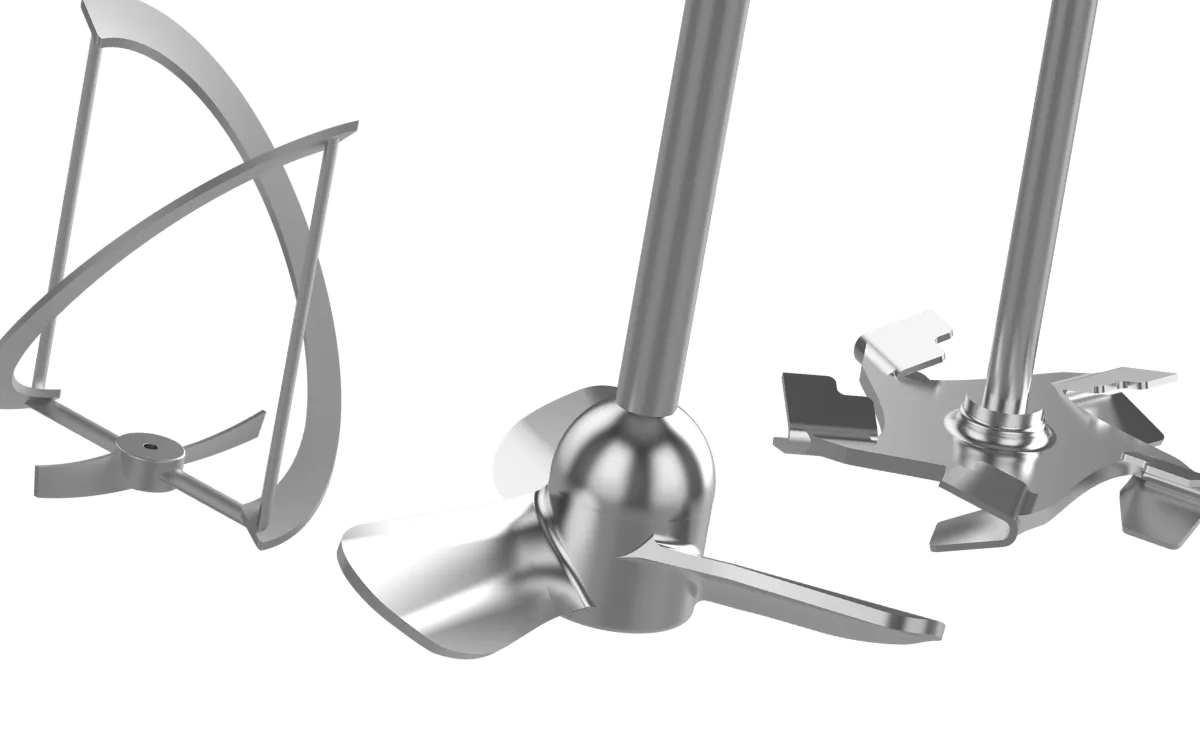
Fixed mixing elements installed inside the pipeline deliver continuous in-line homogenization with no moving parts and no motor. Helical and plate element geometries cover laminar to turbulent regimes — dosing, neutralization, emulsification, gas-liquid contacting and thermal homogenization — at low operating cost and effectively zero maintenance.
Mixing quality is set by element geometry, not by the length of the mixer. We select the right type for your flow regime.
Alternating right- and left-hand 180° twisted strips; homogenization by division and rotation in laminar flow and viscous fluids at a low pressure drop.
Cross-vane lattice structure; high mixing intensity in turbulent regimes and rapid dispersion in low-viscosity liquid-liquid and gas-liquid contacting.
A dosing lance that introduces the chemical into the centre of the stream at the mixer inlet, eliminating wall contact and corrosion risk.
Ra ≤ 0.8 µm internal surface, dead-leg-free transitions, clamp connections and CIP/SIP compatibility for food, pharmaceutical and cosmetic lines.
| Parameter | Helical Element | Plate Element |
|---|---|---|
| Suitable Flow Regime | Laminar / Transitional | Turbulent / Transitional |
| Viscosity Range | Medium – Very High | Low – Medium |
| Pipe Diameter | DN15 – DN1000 | DN25 – DN1000 |
| Typical Element Count | 6 – 24 | 3 – 12 |
| Relative Pressure Drop | Low | Medium – High |
| Body Material | AISI 304 / 316L / Duplex / Hastelloy / Carbon | AISI 304 / 316L / Duplex / Hastelloy / Carbon |
| Connection Type | Flanged / Welded / Clamp | Flanged / Welded / Clamp |
| Hygienic Surface (Ra) | ≤ 0.8 µm (optional) | ≤ 0.8 µm (optional) |
| Typical Application | Polymer, viscous dosing, colouring | Neutralization, emulsification, gas-liquid |
A static mixer continuously divides, rotates and recombines the stream using elements fixed inside the pipe. Because the mixing energy comes from the fluid's own pressure, there is no separate motor, gearbox, shaft or seal. That means no rotating equipment, no seal failures and an essentially maintenance-free installation.
No separate motor — only the pump load of the pressure drop
Seal, bearing and gearbox maintenance disappear entirely
Complete mixing in a short pipe run with a narrow residence time distribution
Integrates into the line without an extra tank or floor space
CIP/SIP-compatible surfaces or explosive-atmosphere certification
Element count calculated from flow rate, viscosity and mixing ratio

Static mixers come into play wherever mixing can be done in the line itself rather than in a tank.
Coagulant/flocculant dosing, pH neutralization and chlorine contact lines
Reactant blending, additive dosing, emulsification and gas absorption
Syrup/concentrate dilution, carbonation and hygienic in-line blending
Sterile in-line dilution, WFI blending and viscous formulation homogenization
Share your flow rate, viscosity, mixing ratio and allowable pressure drop; our engineering team will calculate the element type and count and propose a solution built for your process.
Get a Quote →