Mechanimix
✕
Virtual Showroom Contact

Mining Tank Agitators

Wear-resistant agitators for leach, CIL/CIP, conditioning and slurry tanks, sized from your process data.

500 m³
Reference Tank Volume
60%
Solids, Up To
5
Mining Reference Projects
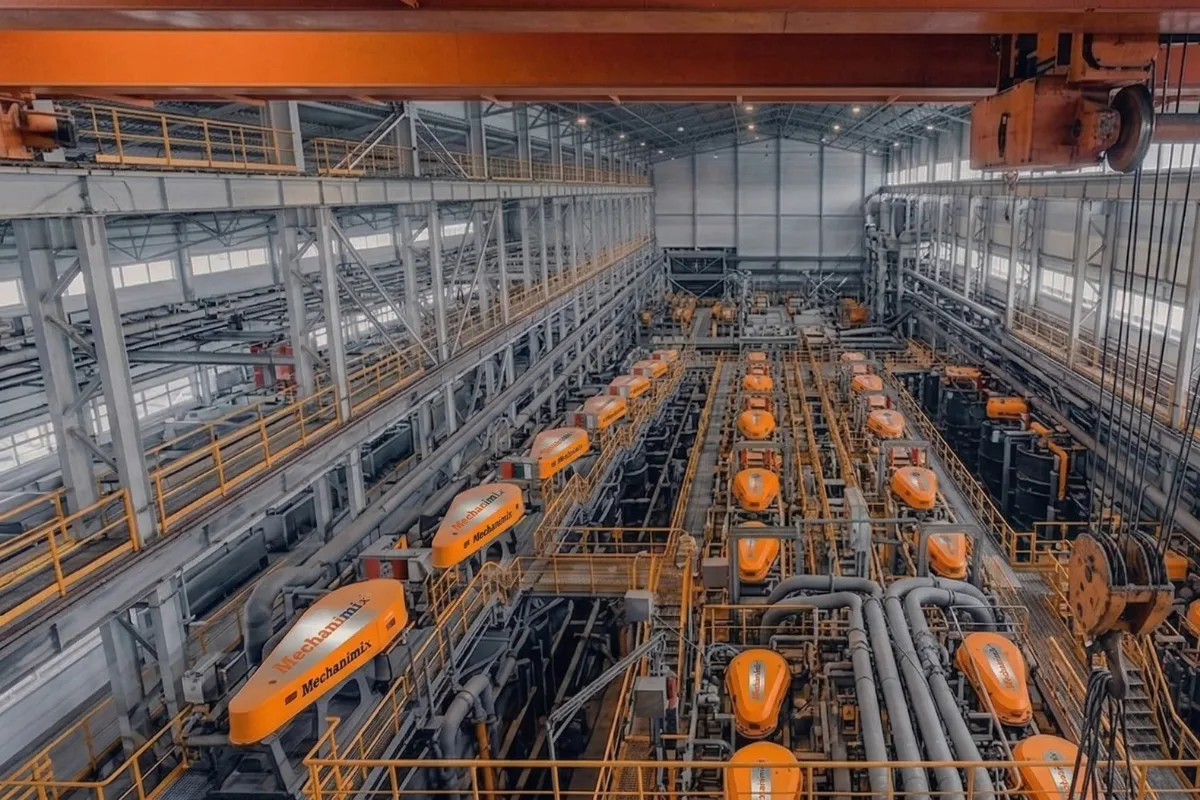
Industrial agitator for mineral processing tanks

What Does an Agitator Do in a Mining Tank?

In a mining tank, the agitator keeps solids in suspension, distributes reagents and gas, and evens out temperature and concentration. If the duty is defined incorrectly, the result is settling on the tank floor, short-circuiting flow and fast impeller wear, which directly reduces metal recovery and plant availability. Mechanimix sizes the impeller, drive and wear protection for each tank's duty from process data.

Torque checks for full suspension and restart from settled solids
Rubber lining for fine solids, wear-resistant metals for coarse solids
Hydrofoil impellers for high pumping at low power
Assessed together with tank series, overflow and baffle layout
PROCESSES

Mixing Duties in Mineral Processing

The same tank volume needs a different agitator in a different process. Here is the duty, the main risk and our approach for each one.

CIL / CIP Gold Leaching

Agitator duty
Keep ore slurry suspended, distribute cyanide and oxygen evenly, and circulate activated carbon through the tank.
Critical risk
High shear abrades activated carbon, and the resulting fines are lost with the gold they carry. Settling reduces contact time.
Our solution
High-flow, low-shear HWM and HWM-B hydrofoil impellers, rubber-lined wetted parts and a flow design matched to the tank series.

Atmospheric Acid Leaching (Copper, Nickel, Zinc, Uranium)

Agitator duty
Maintain acid-to-ore contact and even out reaction heat and concentration across the tank.
Critical risk
Corrosion and abrasion act together. A material chosen for only one of them fails early.
Our solution
Rubber lining, Duplex 2205, Super Duplex or Hastelloy C276, selected by acid type, chloride level and temperature.

Pressure Oxidation (POX) and HPAL Autoclaves

Agitator duty
Keep slurry suspended in multi-compartment autoclaves and improve oxygen or acid contact. HPAL typically runs at approximately 250–270 °C and 40–60 bar.
Critical risk
High temperature, pressure and abrasion combine. Shaft sealing and dynamic loads are the most critical design items.
Our solution
We assess autoclave agitators project by project, with materials, sealing and shaft dynamics engineered for the process.

Bioleaching and Biooxidation (BIOX)

Agitator duty
Distribute the air or oxygen the bacteria need while keeping solids in suspension.
Critical risk
Poor gas distribution reduces bacterial activity. Excess shear and temperature drift also slow the process.
Our solution
A multi-stage layout with a gas dispersion impeller such as GDM at the bottom and an axial-flow impeller above.

Conditioning Ahead of Flotation

Agitator duty
Distribute collectors, frothers and pH reagents evenly within a short residence time.
Critical risk
Short-circuiting lets part of the reagent leave unreacted and increases reagent consumption.
Our solution
Inlet, outlet and baffle layout are designed with the impeller, and HWM circulates the full volume.

Slurry Storage, Surge and Filtrate Tanks

Agitator duty
Keep solids continuously suspended in the buffer between mills, filters and pumps.
Critical risk
The worst case is not normal running but restart: turning an impeller buried in settled solids after a power failure.
Our solution
NP-M agitators with rubber-lined HWM-B impellers, multi-stage layouts in tall tanks, and torque checks for the restart case.

Lime Slaking and Neutralization

Agitator duty
Keep milk of lime suspended and neutralize acidic slurry or waste streams in a controlled way.
Critical risk
Scaling on impellers and shafts causes imbalance and vibration. Local pH swings hurt product quality.
Our solution
Impeller and shaft geometry suited to scaling service, and reagent feed points placed according to the flow field.

Flocculant Make-Up and Dosing

Agitator duty
Dissolve and age polymer without lumps.
Critical risk
High shear breaks polymer chains, which lowers flocculant performance and raises consumption.
Our solution
Low-speed, low-shear mixing with the impeller chosen for solution viscosity.

Boron, Alumina and Salt Precipitation / Crystallization

Agitator duty
Keep crystals suspended and distribute supersaturation evenly through the tank.
Critical risk
High tip speed breaks crystals and creates fines, which hurts filtration and product quality.
Our solution
Low-shear wide-blade impellers, with speed and power set by the crystal size target. See Crystallization.
SELECTION GUIDE

7 Critical Questions When Selecting a Mining Agitator

Clarifying these points before you request a quote leads to the right design and the right price.

CriterionWhy it mattersHow we handle it
Solids content, particle size, densityThese set settling velocity and required power. Power rises quickly with particle size and density.Just-suspended speed is calculated as a starting point (Zwietering correlation) and validated with CFD and pilot data on critical duties.
Suspension levelThere is a large power gap between off-bottom motion and fully homogeneous suspension. Anything beyond the need is operating cost.We set the duty by process: contact for leaching, homogeneity at a pump suction.
Tank geometryAs liquid height grows relative to tank diameter, one impeller no longer reaches the top zone.Multi-stage layouts for tall tanks, with baffle count and impeller position calculated together.
AbrasivenessWear rises steeply with impeller tip speed.Tip speed is limited. Rubber lining for fine solids; wear-resistant castings or hard overlays are assessed for coarse, sharp solids.
CorrosionpH, chlorides and temperature determine material life.Rubber lining, 316L, Duplex, Super Duplex or Hastelloy, selected from the process chemistry.
RestartStarting in settled solids after a power failure is far heavier than normal running.Torque, shaft and drive are checked for this case, and an operating procedure is defined if needed.
Speed controlNot every tank needs a VFD. Unneeded equipment adds cost and failure points.A simple fixed-speed drive is recommended when it meets the duty; a VFD is assessed for variable loads.
ENGINEERING

Design Details That Matter in the Field

Wear Protection

Rubber lining, Cr₂₇ high-chrome castings and Ni-Hard options for impellers and wetted parts, selected by particle size and sharpness.

Heavy-Duty Bearings

Bearing housing and shaft are calculated for load and critical speed, covering the radial loads and imbalance typical of slurry service.

Material Options

AISI 316L, Duplex 2205, Super Duplex and Hastelloy C276, chosen by looking at chemistry and abrasion together.

Explosive Atmospheres

We can design for ATEX and Ex-proof requirements in areas with dust or gas risk.

HOW WE WORK

From Process Data to a Running Agitator

  1. Process dataWe define the duty first: fluid or slurry properties, tank geometry, operating conditions and the result you need.
  2. Hydraulic sizingImpeller type, diameter, speed and power are calculated from that duty, not picked from a catalogue.
  3. CFD validationWhere the risk justifies it, flow, dead zones and blend or suspension behaviour are checked before manufacturing.
  4. Mechanical design and deliveryShaft, bearings, seal, materials and drive are designed for the loads; supply, installation support and commissioning follow.
REFERENCES

Delivered Projects in This Sector

Recommended Equipment for This Sector

The right equipment follows from the process duty. These are the starting points.

NP Series Top-Entry Agitators

The main solution for leach, conditioning and slurry tanks. NP-M and NP-H models.

View details →

Leaching and Extraction Systems

Agitators, tanks and auxiliary equipment for tank-series circuits.

View details →

Impellers

Hydrofoil, gas dispersion and special-duty impellers, with a selection table by process duty.

View details →
FAQ

Frequently Asked Questions

Which impeller is used in a mining slurry tank?+
Solids suspension duties mostly use hydrofoil axial-flow impellers because they deliver high pumping at low power. At Mechanimix, HWM and HWM-B lead for this duty. In abrasive slurry, the impeller is rubber-lined or made from a wear-resistant material.
Should I choose a rubber-lined or a metal impeller?+
Rubber lining usually performs best in fine abrasive slurry. Coarse, sharp particles can cut rubber, so wear-resistant castings or hard-faced metal are assessed instead. Temperature and chemistry also decide the rubber type.
What matters for agitators in CIL and CIP tanks?+
The goal is to keep slurry suspended while abrading activated carbon as little as possible, so high-flow, low-shear impellers are used. Controlled carbon movement between tanks and oxygen distribution are also part of the design.
When does a tank need a dual-impeller agitator?+
When liquid height grows relative to tank diameter, one impeller's flow may not reach the top zone, and a second stage is added. The decision also depends on solids content, particle size and the homogeneity required.
Will the agitator restart after a power failure?+
This scenario has to be addressed at the design stage. If slurry settles, the impeller is buried and starting torque can far exceed normal running torque. Drive and shaft are checked for this case, and a restart procedure is defined for the plant if needed.
Does an agitator need a variable frequency drive (VFD)?+
No. If the duty is met at a single operating point, a fixed-speed drive is simpler and more economical. A VFD can make sense when density or level varies widely, or when starting load needs to be limited.
What data is needed for an agitator quote?+
Tank diameter and liquid height, solids content, particle size, solid and liquid density, temperature, pH or chemistry, process duty and operating pattern are a sufficient start. We can build assumptions together for any data you do not have.
What does CFD add for mining tanks?+
CFD shows flow, dead zones and solids distribution before manufacturing. It reduces the risk of a wrong investment, especially in large tanks, when changing baffles or feed layout, and when improving an existing tank.
Can a new agitator be fitted to an existing tank?+
Yes, in most cases the design can follow the existing bridge, flange and tank dimensions. The load capacity of the structure is checked first, then the impeller and drive are sized for the new duty.
How are agitators selected for boron plants?+
Dissolving and crystallization are treated differently. Dissolving needs fast dispersion of solids, while crystallization needs low-shear flow that does not break crystals, so wide-blade impellers and controlled tip speed are preferred.

Tell Us About Your Tank and Process

Start with your slurry properties and tank dimensions. We will define the duty and size the right agitator with you.

Get a Quote →