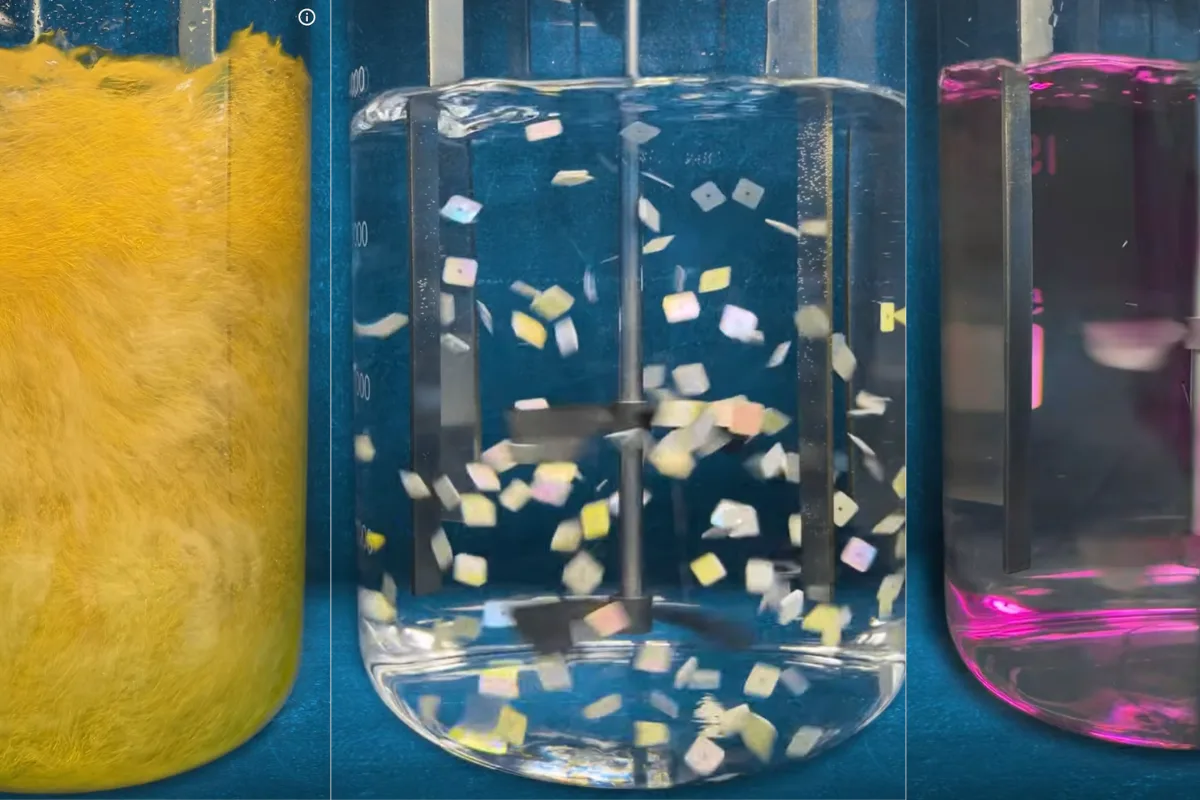
Mixing is the process of combining two or more substances to form a homogeneous blend. Each mixing type demands different flow regimes, impeller geometries and energy inputs. Selecting the correct mixing type directly determines process efficiency and product quality.

Homogenization is the process of converting components with different viscosities, densities or particle sizes into a single uniform mixture. In liquid-liquid systems, concentration gradients are eliminated to achieve a homogeneous structure.
Solid-liquid suspension is the mixing type that ensures solid particles are distributed evenly or in a specific profile within the liquid phase. Settling velocity, particle size and solids concentration are the critical parameters.
Liquid-liquid dispersion is the process of breaking two immiscible liquids (typically oil and water) into fine droplets to form a stable emulsion or dispersion. Droplet size distribution determines product quality.
Gas-liquid dispersion is the process of breaking the gas phase into fine bubbles and distributing them uniformly within the liquid phase. It is fundamental to oxygen transfer, chlorination, hydrogenation and fermentation processes. The mass transfer coefficient (kLa) is the critical performance indicator.
Powder blending is the mixing type that ensures homogeneous distribution of powders, granules and solid materials. Particle size, density differences and cohesion properties determine the blending strategy.
Standard for mixing terminology and fundamental concepts. International definitions of impeller types, flow regimes and mixing parameters.
Mixer design standard; reference guide for impeller and tank geometry, D/T ratios and mounting dimensions.
Mandatory compliance directive for mixing equipment in explosive atmospheres. Ex-proof motor and sensor requirements.
European Pressure Equipment Directive for pressure vessel and reactor mixer applications. Design verification and CE marking.
Hygienic mixer design guidelines. Cleanability and sterilization for food, pharmaceutical and biotechnology applications.
Let our engineering team analyze your process with CFD simulation and design the most efficient mixing solution.
Get a Free Quote →