Mechanimix
Virtual Showroom Contact

Bioreactor and Fermentation Systems

Sterile-designed, kLa-optimized, CIP/SIP-compliant and GMP-ready bioreactor systems for cell culture and microbial fermentation.

10 L – 50 m³
Scale Range
kLa
Optimized Oxygen Transfer
CIP/SIP
Sterile Design
GMP Ready
Compliance
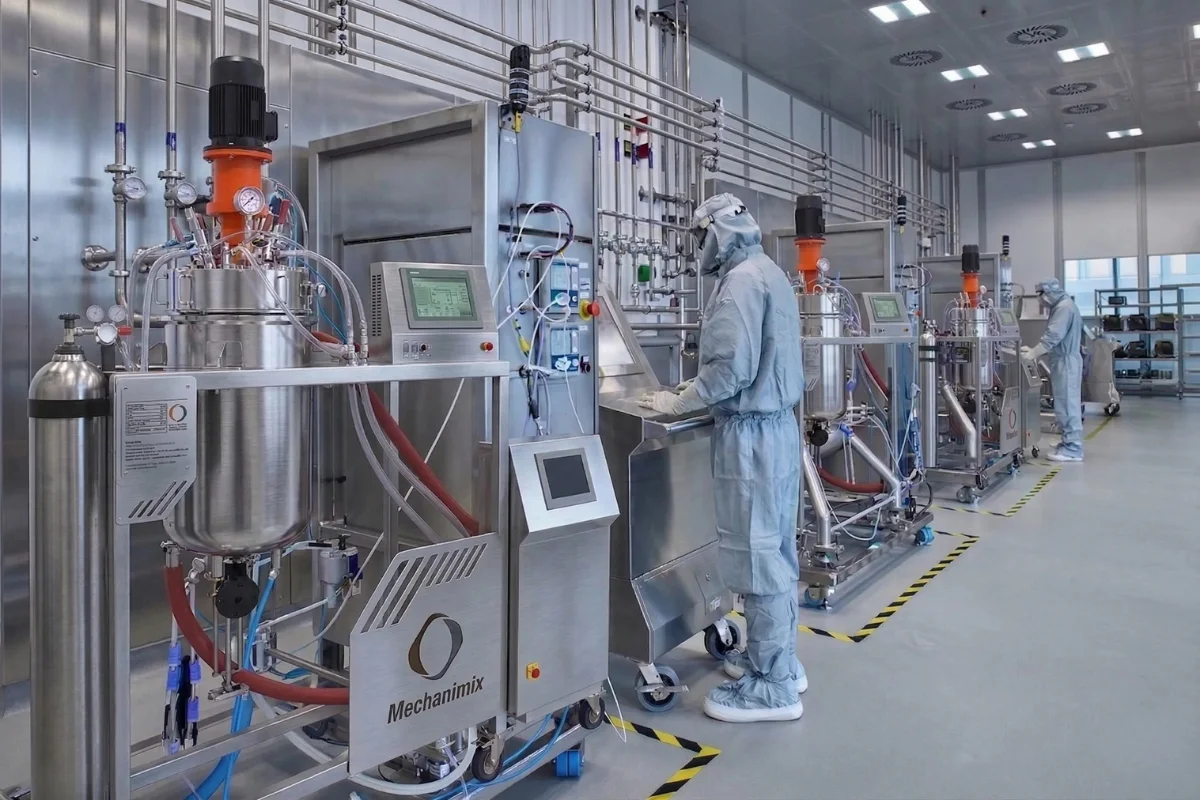
Bioreactor and fermentation system — GDM gas distribution and axial impeller
GENEL BAKIŞ

Mechanimix Approach to Bioreactor Systems

The success of a bioprocess depends on simultaneously delivering oxygen transfer rate (kLa), controlled shear on the cells, sterile barrier integrity and tight pH/DO control. Mechanimix bioreactors offer scale-up confidence from lab scale up to 50 m³ production scale with a kLa-optimized GDM/HWM impeller combination, optional bottom-entry magnetic coupling, electro-polished internal surface and full CIP/SIP capability.

kLa-Optimized Mixing

High oxygen transfer efficiency through a GDM gas-distribution impeller + HWM axial impeller combination.

Low Shear

Impeller geometry operating at low tip speed in the laminar regime for cell culture.

Sterile Barrier

Double mechanical seal + steam barrier completely eliminates contamination risk.

CIP/SIP Compatible

Spray-ball coverage and 135°C SIP capability meet FDA and GMP requirements.

PAT Integration

DO, pH, OD, CO₂, temperature and foam sensors are connected to DCS/SCADA via a PAT framework.

Scale-Up Confidence

Transition from 10 L pilot to 50 m³ production using kLa, P/V or tip-speed constancy strategies.

SİSTEM BİLEŞENLERİ

System Components

Main Mechanimix equipment used in the bioreactor and fermentation line.

UYGULAMA ALANLARI

Uygulama Alanları

Antibiotic Fermentation

High-kLa bioreactors for production fermentations such as penicillin and cephalosporin.

Enzyme Production

Microbial fermentation of industrial enzymes: amylase, protease, lipase.

Bioethanol

Yeast fermentation with CO₂ management and thermal regime at 50 m³+ scale.

Monoclonal Antibody

Low shear, precise DO/pH control and scale-up for CHO cell culture.

TEKNİK ÖZELLİKLER

Teknik Özellikler

ÖzellikDeğer
Capacity Range10 L – 50 m³
MaterialAISI 316L / L-grade, Ra ≤ 0.5 µm elektro-polisaj
Design Pressure−1 / +4 bar (SIP için)
SterilizationCIP 80°C / SIP 135°C
Impeller TypeGDM + HWM kombinasyonu
Tip Speed0,5 – 2,5 m/s (hücreye göre)
kLa100 – 500 h⁻¹ (aplikasyona göre)
StandardsASME BPE, FDA, EU GMP Annex 1
NEDEN MECHANIMIX

Why Mechanimix?

Bioprocess Engineering

Scale-up calculations based on kLa, P/V or tip-speed constancy are performed by our team.

Sterile Design Verification

Drainability, riboflavin coverage test and dead-leg analysis are reported prior to commissioning.

Bottom-Entry Expertise

Zero leakage with BED-N magnetic coupling — no contamination risk in aseptic production.

Validation Support

IQ/OQ protocols, FAT/SAT and material certificates delivered as a complete package.

SIKÇA SORULAN SORULAR

Sıkça Sorulan Sorular

What is kLa and why is it critical in a bioreactor?+
kLa (volumetric oxygen transfer coefficient, h⁻¹) is a measure of how fast oxygen is transferred from the gas phase to the liquid, and it is the main growth-limiting parameter in aerobic fermentation. Insufficient kLa leads to oxygen limitation and thus lower product yield; excessive kLa simply wastes energy and shear. Design targets are typically 100–500 h⁻¹ for microbial fermentations and 5–20 h⁻¹ for mammalian cell culture.
How does the GDM impeller achieve microbubble distribution?+
The GDM hollow-blade self-inducing impeller aspirates gas through the low-pressure region behind the blades and shears it into microbubbles. As a result, for the same power input it delivers 30–50% higher kLa than a classical Rushton turbine and increases O₂ utilization efficiency through gas recirculation.
What are the critical points of sterile design?+
Critical points are drainability (no residual liquid in tank and piping), dead-leg length not exceeding 2× the pipe diameter, electro-polished internal surface (Ra ≤ 0.5 µm) and sanitary tri-clamp/flange connections. Seals must use double mechanical + steam barrier; gas lines require 0.22 µm sterile filters. These criteria are documented according to ASME BPE.
How are CIP and SIP applied?+
CIP (Cleaning In Place) is carried out without opening the tank, through spray balls with 1–2% caustic and nitric acid solutions at 60–80°C; a minimum surface velocity of 2.5 m/s is required for turbulent film formation. SIP (Sterilization In Place) uses saturated steam at 121–135°C for 30 minutes and the tank must achieve F₀ ≥ 15 minutes. Both processes are captured as recipes in the DCS.
How is scale-up from 10 L pilot to 50 m³ production performed?+
Scale-up preserves geometric similarity (D/T, H/T ratios) while one of three criteria is held constant: equal P/V (power per unit volume), equal kLa or equal tip speed. P/V or kLa are preferred in aerobic fermentations, while tip speed is held constant in sensitive cell cultures. CFD validates mixing time and shear distribution, and the impeller configuration is revised if needed.

Projeniz İçin Ücretsiz CFD Analizi

Proses ihtiyaçlarınıza en uygun sistem konfigürasyonu için mühendislik ekibimizle görüşün. İlk değerlendirme ve ön fizibilite ücretsizdir.

Teklif Alın