Mechanimix
Virtual Showroom Contact

Chemical Industry

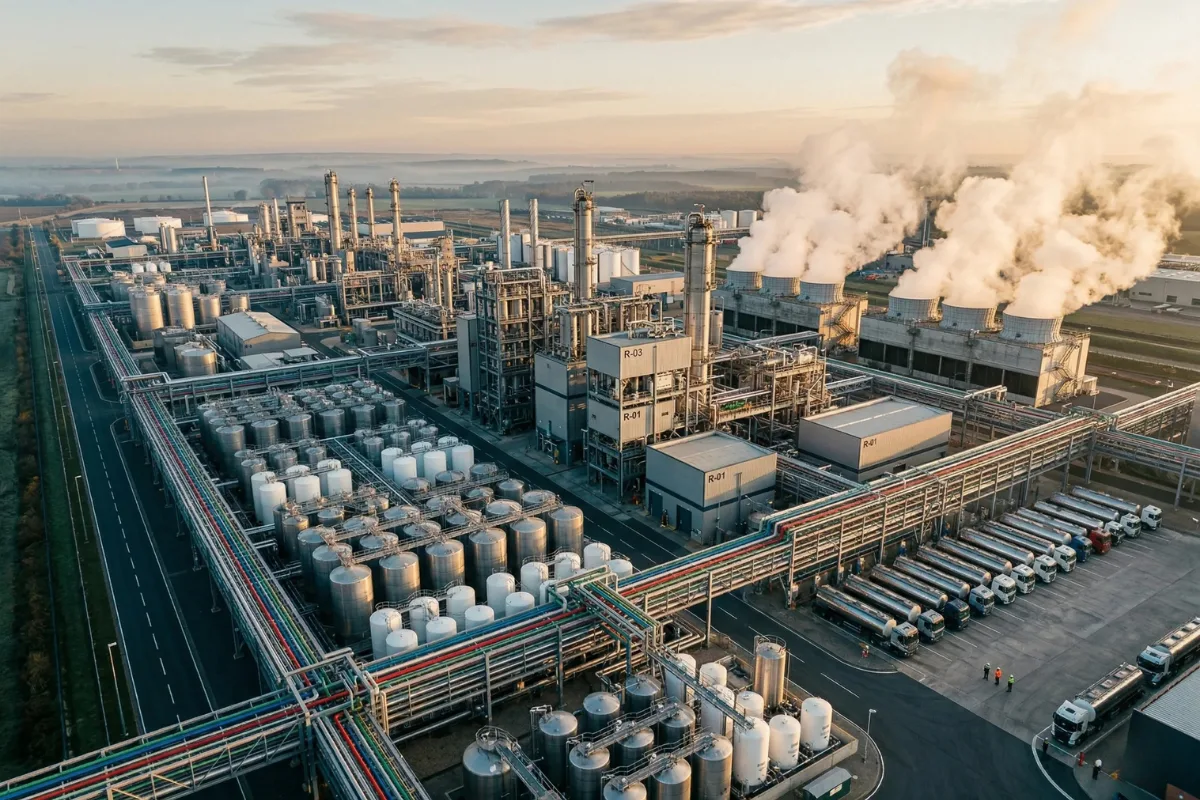
The chemical industry relies on mixing technology at the heart of its production processes. From reaction kinetics to heat transfer, polymerization to crystallization, the correct mixer selection in every process directly determines product quality and efficiency. Mechanimix delivers specialized solutions for the chemical sector with over 10 years of experience and a CFD-driven engineering approach.

12+
Process Types
200 kW
Max. Motor Power
150 bar
Operating Pressure
Chemical Industry
OVERVIEW

Critical Mixing Solutions for the Chemical Sector

Mechanimix provides industrial mixing solutions for base chemicals, fine chemicals, polymers and fertilizer production in the chemical industry. CFD-driven impeller selection and reactor design deliver optimum mixing efficiency, product quality and energy savings across a wide range of processes, from low-viscosity solutions to high-viscosity polymers.

CFD-Driven Flow Analysis in Reactor Design
Corrosion-Resistant Material Selection (Hastelloy, Duplex, Titanium)
ATEX Certified Explosive Atmosphere Solutions
Gas-Liquid Mass Transfer Optimization
Laboratory to Industrial Scale-Up Engineering
PROCESS TYPES

Mixing Processes in the Chemical Sector

Each process type requires different mixing parameters, impeller geometry and material selection.

Polymerization

Homogeneous temperature and concentration distribution during monomer conversion. Custom impeller designs for bulk, solution and suspension polymerization.

Crystallization

Precise mixing for controlled nucleation and crystal growth. HWM low-shear impellers provide particle size distribution and morphology control. Flow patterns in cooling and anti-solvent crystallization are optimized via CFD.

Hydrogenation

Catalytic hydrogenation in high-pressure gas-liquid reactors. Gas dispersion and mass transfer optimization with GDM impellers at operating pressures up to 150 bar in the HP series. Hastelloy and Titanium material options available.

Emulsification

Stable droplet size distribution in water-in-oil and oil-in-water emulsions. Sub-micron emulsion quality through high-shear rotor-stator and inline homogenizer integration. Surfactant distribution is modeled via CFD.

Heat Transfer

Effective heat exchange via jacket/coil in exothermic and endothermic reactions. Enhanced heat transfer coefficients in viscous media.

Gas-Liquid Mixing

Gas dispersion in oxidation, chlorination and fermentation processes. Surface aeration and submerged mixing solutions.

SUBCATEGORIES

Sectors We Serve in the Chemical Industry

Base Chemicals
Fine Chemicals
Specialty Chemicals
Polymers & Resins
Active Pharmaceutical Ingredients (API)
Fertilizers & Agrochemicals
Paints & Pigments
Adhesives & Sealants
Surfactants
WHY MECHANIMIX

Why Mechanimix for the Chemical Sector?

Every process in the chemical sector is unique. Reactor geometry, fluid properties, reaction kinetics and heat transfer requirements must be evaluated as a whole. Mechanimix designs the most efficient mixing solution by modeling your process conditions digitally through CFD simulation.

100+
Completed Projects
30%
Energy Savings
10+
Years of Experience
8
Industry Expertise

Recommended Products for This Industry

Let us determine the most suitable mixer solution for your process conditions together

Top Entry Mixers

The most common solution for chemical reactors and process tanks. HP series for high pressure, NP series for atmospheric processes.

Learn More →

Side Entry Mixers

Raw material homogenization and sedimentation prevention in large storage tanks. Compact design providing continuous homogeneity with low energy consumption; an ideal solution for chemical tank farms.

Learn More →

Bottom Entry Mixers

For emulsion and polymerization reactor processes where the tank top must remain clear. Zero leakage with BED-N magnetic coupling; safe operation under high pressure and vacuum thanks to magnetic drive.

Learn More →
STANDARDS & COMPLIANCE

Compliance and Certifications

ATEX 2014/34/EU

Mixer design for Zone 1 and Zone 2 explosive atmospheres

IECEx

International explosive atmosphere equipment certification

PED 2014/68/EU

Pressure Equipment Directive; reactor and pressure vessel design

ASME Section VIII

Pressure vessel design and manufacturing standard

NACE MR0175

Material selection for corrosive environments (H₂S-containing processes)

ISO 21049

Mechanical seal design and application standard

FREQUENTLY ASKED QUESTIONS

Frequently Asked Questions

Which mixer type is used in the chemical industry?+
It depends on the process type. HWM wide-blade impellers are preferred for polymerization, HM hydrofoil impellers for crystallization, and GDM gas-dispersing impellers for gas-liquid reactions. Viscosity, temperature and pressure conditions determine the selection.
Which impeller type should be preferred for high-viscosity fluids?+
For viscosities above 1,000 cP, the HVM high-viscosity impeller is recommended. Its narrow blade geometry maximizes shear force near the vessel wall. Adjustable blade angle provides an advantage in non-Newtonian fluids.
When is ATEX certification required for a reactor mixer?+
ATEX is mandatory in environments containing flammable gases, vapors or dusts. The motor, sensors and control unit are selected according to Zone 1 (explosive atmosphere during normal operation) and Zone 2 (under abnormal conditions) classifications.
How is CFD analysis used in mixer selection?+
CFD simulation pre-models in-tank flow patterns, dead zones, heat transfer and mixing time. It eliminates the need for physical prototypes, saving cost and time. Mechanimix offers CFD validation on all projects.
What should the mixing speed be in a crystallization process?+
Controlled nucleation in crystallization requires low tip speeds (1-3 m/s) and homogeneous energy distribution. High shear forces break crystals; the HWM impeller provides ideal suspension with low shear. Process parameters are optimized via CFD.

Free CFD Analysis for Your Chemical Process

Let our engineering team analyze your chemical processes with CFD simulation and design the most efficient mixing solution.

Get a Free Quote