Mechanimix
Virtual Showroom Contact

GMP Process Tanks

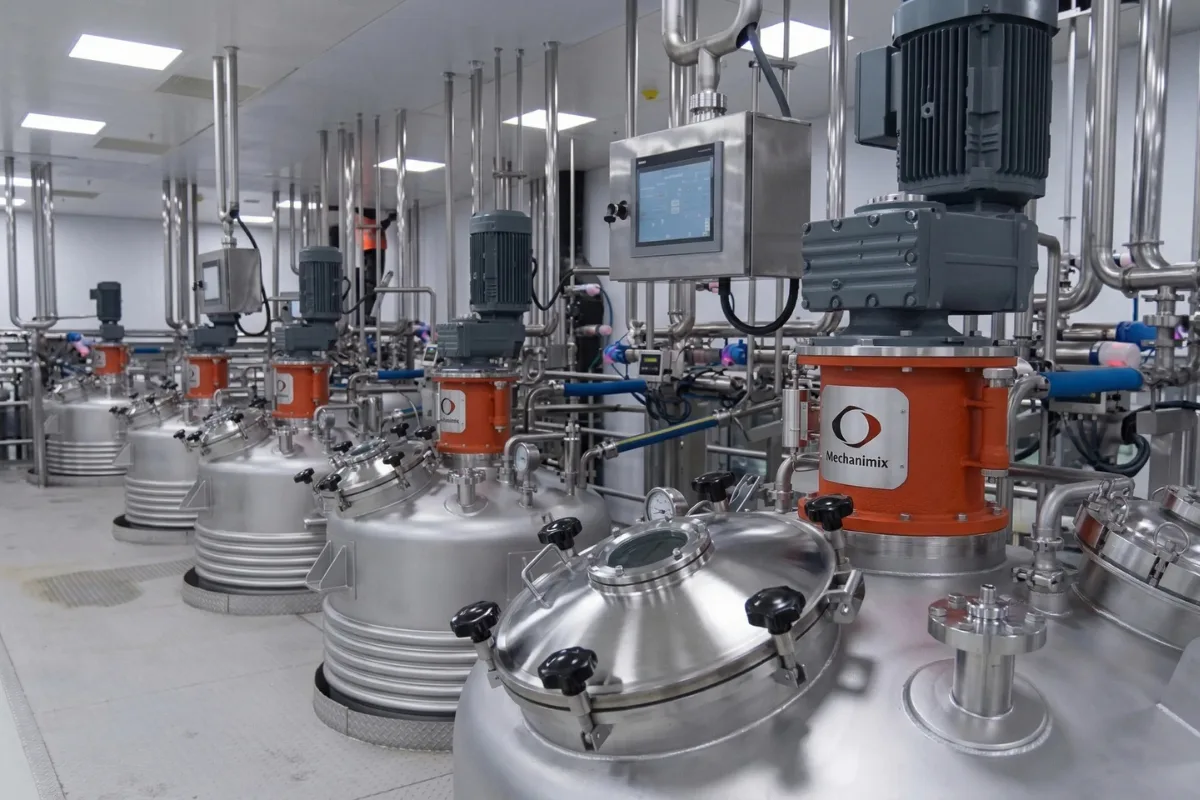
GMP, FDA and ASME BPE-compliant sanitary process tanks for pharmaceutical and cosmetic production, with BED-N bottom-entry magnetic coupling mixer, electro-polished internal surface and full CIP/SIP capabilities.

Ra ≤ 0.4 µm
Surface Roughness
AISI 316L
Sanitary Material
BED-N
Zero-Leak Guarantee
ASME BPE
Standard Compliant
GMP process tank — sanitary design and bottom-entry mixer
GENEL BAKIŞ

Mechanimix Approach to GMP Process Tanks

In pharmaceutical and cosmetic production, process tanks require that all product-contact surfaces are fully safe against cross-contamination, bacterial build-up and particle retention. Mechanimix GMP tanks meet ASME BPE + EU GMP Annex 1 requirements through AISI 316L L-grade material, Ra ≤ 0.4 µm electro-polish, full drainability, BED-N bottom-entry magnetic coupling mixer and an integrated CIP/SIP system.

Sanitary Design

Dead-leg < 2D, fully drainable, electro-polished internal surface and tri-clamp connections.

Bottom-Entry Mixer

BED-N magnetic coupling keeps the headspace clean, with zero leakage and easy CIP.

CIP/SIP Compatible

Dual spray balls and cleaning coverage verified by riboflavin testing.

Double-Wall Temperature Control

Dimple or half-pipe jacket; heating/cooling ramps with ±1°C accuracy.

Validation Package

Full set of material certificates (3.1), riboflavin, boroscope and IQ/OQ documents.

Custom Sizing

Sizes and configurations from a 50 L site pilot up to a 30 m³ production tank.

SİSTEM BİLEŞENLERİ

System Components

Sanitary Mechanimix equipment used in the GMP process tank line.

BED-N

BED-N Bottom-Entry Mixer

Bottom-entry mixer driven by a magnetic coupling, zero leakage, GMP-compliant.

Detaylı İncele
HWM

HWM Axial Impeller

Low-shear, high-pumping axial impeller; ideal for sensitive products.

Detaylı İncele
HM

HM Marine Impeller

Marine-type impeller delivering low-viscosity flow for emulsion and cream tanks.

Detaylı İncele

CIP Spray Ball System

360° sanitary spray ball with full coverage verified by riboflavin test.

Thermal Jacket

Dimple or half-pipe outer jacket with ±1°C control via TCU.

Sanitary Mechanical Seal

Double mechanical seal + steam barrier, certified for aseptic environments.

UYGULAMA ALANLARI

Uygulama Alanları

API Solution Preparation

Dissolution and homogenization of active pharmaceutical ingredients in solvent.

Buffer Vessel

Preparation and sterile storage tanks for pH buffer solutions.

WFI Storage

Water for Injection (WFI) storage; circulation above 80°C, sanitary loop.

Creams and Emulsions

Vacuum mixer tanks for oil-in-water emulsions in cosmetic products.

TEKNİK ÖZELLİKLER

Teknik Özellikler

ÖzellikDeğer
Capacity Range50 L – 30 m³
MaterialAISI 316L L-grade (Fe/S kontrol)
Internal Surface RoughnessRa ≤ 0.4 µm (elektro-polisaj)
Design Pressure−1 / +6 bar (SIP için)
SterilizationCIP 80°C / SIP 135°C @ F₀ ≥ 15
MixerBED-N alttan girişli manyetik kaplin
ConnectionsTri-clamp / DIN 11864 sanitary
StandardsASME BPE, EU GMP Annex 1, FDA 21 CFR
NEDEN MECHANIMIX

Why Mechanimix?

ASME BPE Compliance

Design, manufacturing and documentation are fully compliant with the ASME BPE standard.

Easier Validation

Riboflavin coverage, drainability and boroscope reports delivered at the FAT stage.

Zero Cross-Contamination

Leakage risk eliminated with BED-N bottom-entry and residue risk with dead-leg < 2D.

Single-Source Responsibility

Tank, mixer, CIP system and controls from one source — no multi-vendor issues.

SIKÇA SORULAN SORULAR

Sıkça Sorulan Sorular

Why are bottom-entry mixers preferred in GMP tanks?+
With a top-entry mixer the shaft passes through the tank, creating a hard-to-clean zone in the headspace and a potential contamination source at the seal. In a bottom-entry mixer the headspace remains completely clean, aseptic gas blanketing is simpler and spray-ball coverage during CIP is improved. It also maintains homogeneity even at low fill levels.
How does the BED-N magnetic coupling guarantee zero leakage?+
In a magnetic coupling, a hermetic stainless shell separates the motor side (outer magnet) from the impeller side inside the tank (inner magnet), and torque is transmitted through the magnetic field. Because there is no dynamic seal there is no risk of mechanical wear or leakage — a critical advantage in aseptic production and toxic API applications. It also tolerates 135°C steam during SIP without issues.
Why is Ra ≤ 0.4 µm surface roughness important?+
As surface roughness increases, micro-pits become havens for bacterial adhesion and biofilm formation, and particle/protein retention rises. ASME BPE mandates Ra ≤ 0.5 µm for product-contact surfaces; Mechanimix guarantees Ra ≤ 0.4 µm through mechanical polishing + electro-polishing (EP). EP also raises the chromium-to-iron ratio, improving corrosion resistance.
What is the main difference between CIP and SIP?+
CIP (Cleaning In Place) is chemical cleaning; caustic + acid solutions at 60–80°C are sprayed over product residues through spray balls, targeting visible cleanliness and allergen removal. SIP (Sterilization In Place) is sterilization; saturated steam is applied at 121–135°C for a minimum of F₀ ≥ 15 minutes to reduce viable microbial load by 6 logs. In GMP production, CIP runs after every batch while SIP runs before aseptic processes.
What should be considered when designing a WFI system?+
For USP/EP WFI quality a continuous circulation loop (above 80°C or < 4°C), zero dead-leg design and periodic sanitization are mandatory — static water is always a bacterial risk. The loop is designed for turbulent flow (Re > 4,000) and sanitized at 121°C at least once a month. The storage tank is equipped with a sanitary spray ball, hydrophobic 0.22 µm vent filter and continuous conductivity/TOC monitoring.

Projeniz İçin Ücretsiz CFD Analizi

Proses ihtiyaçlarınıza en uygun sistem konfigürasyonu için mühendislik ekibimizle görüşün. İlk değerlendirme ve ön fizibilite ücretsizdir.

Teklif Alın