Mechanimix
✕
Virtual Showroom Contact

Biotechnology Mixers

Mixing solutions for microbial fermentation, cell culture, media preparation and scale-up that address oxygen transfer, shear and foam together.

10 L – 50 m³
Bioreactor Scale Range
0.5–2 VVM
GDM Gas Capacity
134°C
BED-N SIP Temperature, Up To
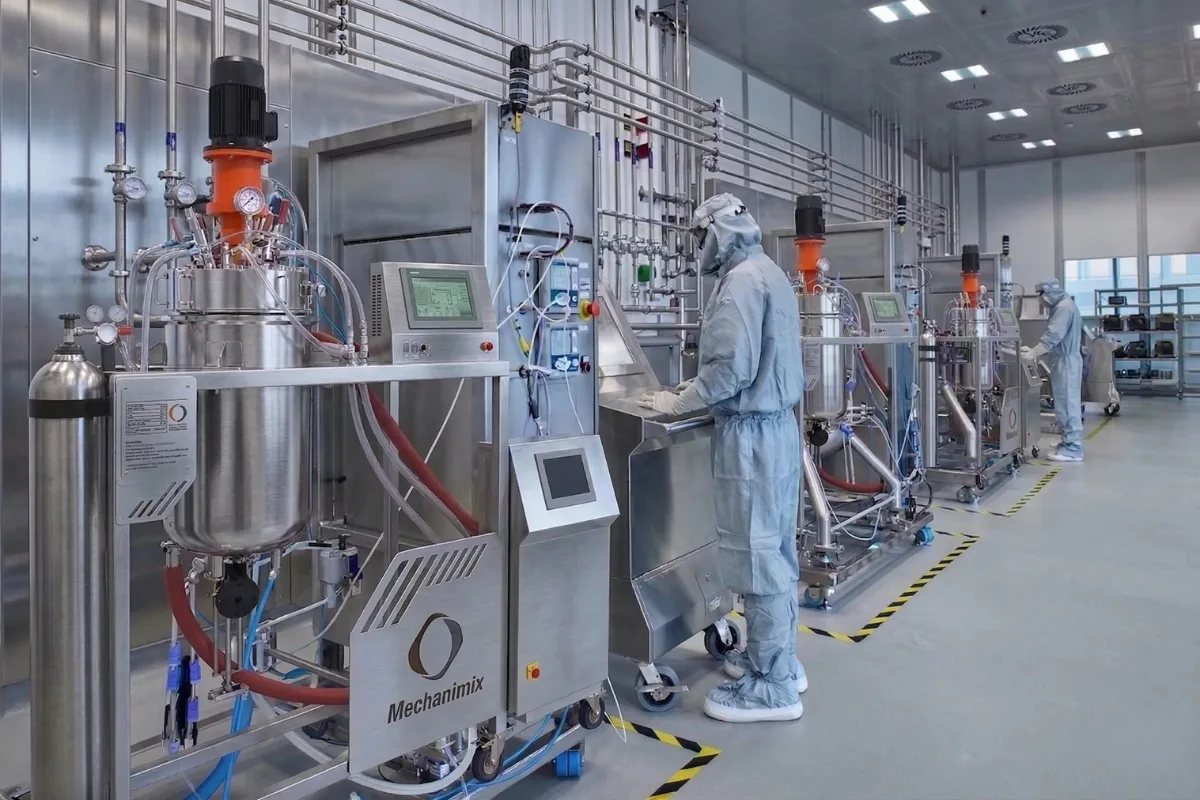
Mixer for bioreactors and fermentation tanks

What Does a Mixer Do in a Bioreactor?

In a bioreactor, the mixer delivers oxygen to the culture, evens out nutrients, pH and temperature, and keeps cells and solids in suspension. If the duty is defined incorrectly, the result is oxygen limitation, shear-related cell loss, foam-over and lost yield during scale-up. Mechanimix sizes the impeller layout, gas dispersion and sealing for each culture's needs from process data.

Gas dispersion with GDM, GM and GDS for microbial fermentation
Low tip speed HWM-B and HWM for cell culture
kLa, foam and CO₂ removal assessed together
Scale-up calculations from RP pilot reactor to production
PROCESSES

Mixing Duties in Bioprocesses

Bacteria, yeast, fungi and mammalian cells do not need the same mixer. Here is the duty, the main risk and our approach for each process.

Aerobic Microbial Fermentation

Agitator duty
Deliver oxygen to bacteria and yeast, distribute nutrients and pH correction agents, and carry metabolic heat to the cooling surface.
Critical risk
Oxygen demand and heat load rise together as cell density increases. If the impeller floods with gas, dissolved oxygen falls and yield is lost.
Our solution
GDM or GDS on the lower stage, with HWM above to circulate the volume. Power is calculated for gassed conditions. See Fermentation.

Viscous Cultures: Fungal and Polysaccharide Fermentation

Agitator duty
Carry oxygen, nutrients and heat through the full volume of a broth whose viscosity rises during the run and thins under shear.
Critical risk
In a pseudoplastic broth, a mixed zone forms around the impeller while distant volume stays nearly stagnant. Oxygen limitation cuts product formation, and excess shear can harm fungal morphology.
Our solution
A multi-stage layout with GDS below and HWM-B above. Calculations use the most viscous point of the run, and the layout is assessed per project if the impeller's viscosity range is exceeded.

Cell Culture (Low Shear)

Agitator duty
Keep mammalian and insect cells suspended, even out nutrients and pH, supply oxygen at low gas flow and remove CO₂.
Critical risk
Cells without a cell wall are sensitive to mechanical stress. Much of the damage comes from bubbles bursting at the surface, and tip speed is even more critical with microcarriers. Too little mixing creates pH and nutrient gradients.
Our solution
Wide-blade HWM-B or HWM at low tip speed. Speed is set from cell line data, and gas flow, bubble size and foam are addressed together.

Media Preparation

Agitator duty
Dissolve media powders and concentrates without lumps and even out composition across the full volume before sterile filtration or sterilization.
Critical risk
Powder floats or forms lumps, and undissolved material blocks filters. Longer preparation times raise bioburden and component stability concerns.
Our solution
Magnetically coupled BED-N keeps working at low fill levels. Powder addition point and dissolution time are planned, and a CIP/SIP compatible build makes batch changeover easier.

Oxygen Transfer (kLa) and CO₂ Removal

Agitator duty
Break gas into fine bubbles, increase their residence time in the liquid and spread the gas phase through the full volume.
Critical risk
Typical literature kLa values are 50-200 h⁻¹ at lab scale, 20-100 h⁻¹ at pilot scale and 10-50 h⁻¹ in large fermenters, so kLa tends to fall with scale. CO₂ accumulation is a separate limit in large cell culture tanks.
Our solution
Sparged GDM, self-aspirating GM or hybrid GDS. The kLa target is calculated from oxygen demand, and sparger, gas flow and speed are chosen together. See Oxygen transfer in fermentation.

Foam Control

Agitator duty
Manage the upper zone of a gassed culture with flow that limits foam build-up, and distribute antifoam into the liquid quickly.
Critical risk
Foam can block the exhaust filter, raise pressure and open a contamination path. Excess antifoam lowers kLa and complicates downstream purification.
Our solution
Gas flow, top stage depth and headspace volume are defined together. Foam sensing and antifoam dosing are integrated into the system, and a mechanical foam breaker is assessed per project if needed.

Scale-Up

Agitator duty
Recreate the mixing, oxygen transfer and shear conditions of the pilot at production scale.
Critical risk
No single criterion preserves everything: constant tip speed lowers P/V and kLa, and constant P/V raises tip speed. Mixing time grows, substrate and pH gradients form at the feed point, and cooling surface shrinks relative to volume.
Our solution
Work starts from RP pilot reactor data (5–100 L, optional gas sparging). P/V or kLa governs microbial processes and tip speed governs sensitive cell culture, with production geometry checked by CFD.

Enzyme Production and Post-Harvest Tanks

Agitator duty
Distribute oxygen and feed solution during fermentation, then keep the enzyme solution and stabilizers homogeneous after harvest.
Critical risk
Oxygen demand changes quickly during feed and induction phases. After harvest, excess shear, foam and air entrainment can reduce enzyme activity.
Our solution
A GDM and HWM layout in the fermenter, with a VFD for variable loads. Low-shear HWM-B or BED-N in harvest and formulation tanks.

Vaccine and Protein Preparation Steps

Agitator duty
Prepare buffers, keep harvest liquid homogeneous, distribute inactivation agent or precipitant quickly, and keep adjuvanted suspensions uniform.
Critical risk
If precipitant or inactivation agent disperses slowly, local high concentration damages protein and the batch is not uniform. If adjuvant settles, dose uniformity suffers.
Our solution
BED-N for small, variable batches and low-shear HWM or HWM-B for precipitation. Feed enters at a high-flow zone. For ethanol precipitation, we can design for ATEX and Ex-proof requirements.
SELECTION GUIDE

7 Critical Questions When Selecting a Bioreactor Mixer

The right result does not come from a single speed value. It comes from defining culture, gas and geometry together.

CriterionWhy it mattersHow we handle it
Culture type and shear toleranceBacteria and yeast tolerate high power input. Mammalian cells and microcarriers do not. The shear limit decides the impeller type.Gas dispersion impellers for microbial cultures and low tip speed HWM-B and HWM for cell culture. The limit is confirmed with cell line data.
Oxygen demand and kLa targetIf oxygen transfer falls short of demand, growth and product formation slow down. Extra transfer means unnecessary power and shear.The kLa target is calculated from peak oxygen demand. Impeller, sparger, gas flow and speed are selected to meet it.
Broth rheologyViscosity can change during a run. In shear-thinning broths, zones far from the impeller stagnate.Calculations use the most viscous point of the run. Multi-stage layouts and larger impeller diameters are assessed if needed.
Foam and headspaceFoam can block filters, limits working volume and increases antifoam demand.Working volume is set by foaming behavior. Foam sensing, antifoam dosing and gas flow are planned together.
Sterile barrierIn a long culture, one contamination loses the whole batch. The shaft penetration is the most critical point.Magnetically coupled BED-N within its torque range, and a steam-barrier double mechanical seal at higher power.
Scale and transfer criterionGeometric similarity is not enough on its own. P/V, tip speed, kLa and mixing time cannot all be preserved at once.The parameter that limits the process is identified first, and scale-up follows it. CFD is used for higher-risk transfers.
Heat loadMetabolic heat grows in high-density fermentation, while cooling surface shrinks relative to volume as scale rises.Jacket capacity is checked against heat load. Internal cooling surfaces are designed with the impeller layout if needed.
ENGINEERING

Details That Matter for Sterility and Performance

Sterile Barrier

Drive without a dynamic seal through the magnetic coupling on BED-N, and a steam-barrier double mechanical seal option on bioreactor systems.

Gas Dispersion Layout

GDM works with perforated and non-perforated spargers. GM needs no external sparger, while GDS helps prevent gas pockets and supports suspension in gassed conditions.

Hygienic Surfaces and CIP/SIP

AISI 316L, Ra ≤ 0.4 µm electropolished surfaces and SIP up to 134°C on BED-N. Our approach is hygienic design that takes GMP requirements into account.

Documentation

Documentation scope is clarified at the quotation stage according to project requirements. Share the documents and test steps you expect at the first meeting.

HOW WE WORK

From Process Data to a Running Agitator

  1. Process dataWe define the duty first: fluid or slurry properties, tank geometry, operating conditions and the result you need.
  2. Hydraulic sizingImpeller type, diameter, speed and power are calculated from that duty, not picked from a catalogue.
  3. CFD validationWhere the risk justifies it, flow, dead zones and blend or suspension behaviour are checked before manufacturing.
  4. Mechanical design and deliveryShaft, bearings, seal, materials and drive are designed for the loads; supply, installation support and commissioning follow.

Recommended Equipment for This Sector

The right equipment follows from the process duty. These are the starting points.

Bioreactor and Fermentation Systems

Systems from 10 L to 50 m³ for cell culture and microbial fermentation.

View details →

BED-N Bottom-Entry Mixer

Magnetically coupled hygienic mixer for media, buffer and harvest tanks.

View details →

Impellers

GDM, GM and GDS gas dispersion impellers plus low-shear HWM and HWM-B, with a selection table by process duty.

View details →
FAQ

Frequently Asked Questions

Which impeller is used in a bioreactor?+
It depends on the culture: gas dispersion impellers for microbial fermentation and low tip speed axial impellers for cell culture. At Mechanimix, GDM, GM and GDS lead the first group, and HWM-B and HWM lead the second. In tall fermenters these impellers work together in a multi-stage layout.
What is kLa and how can it be increased?+
kLa is the volumetric mass transfer coefficient that describes how fast oxygen moves from gas to liquid. It increases with power input, gas flow and better bubble dispersion. Foam and antifoam can lower it, so the target is calculated from oxygen demand instead of chasing the highest value.
How is mixer speed set for cell culture?+
Speed is set by starting from the lowest value that keeps cells suspended and evens out pH and nutrients. In our bioreactor systems, tip speed is selected in the 0.5–2.5 m/s range according to cell type. With microcarriers, the limit is checked more closely.
How is foam controlled in a fermenter?+
Foam is controlled with sensing, antifoam dosing, gas flow and sufficient headspace. Excess antifoam lowers kLa, so dosing follows actual need. Whether a mechanical foam breaker is needed is assessed per project from foaming behavior.
How is bioreactor scale-up done?+
The parameter that limits the process is identified and preserved at production scale. Aerobic fermentation usually follows P/V or kLa, while sensitive cell culture follows tip speed. Mixing time and shear distribution are checked with CFD.
Which seal is used on a sterile bioreactor?+
A magnetic coupling or a steam-barrier double mechanical seal is used. A magnetic coupling removes the dynamic seal but has limited torque capacity. High-power gassed fermenters are often better served by a mechanical seal arrangement.
What is the difference between a microbial fermenter and a cell culture bioreactor?+
The difference is oxygen demand and shear tolerance. A microbial fermenter targets high kLa with high power and gas flow, while a cell culture bioreactor runs with low shear and low gas flow. This changes the impeller type, sparger and cooling needs.
Can the mixer on an existing fermenter be replaced?+
Yes, in most cases a new impeller layout can be designed for the existing tank. Shaft, bearings, drive and seal are checked first to confirm they can carry the new load. Gas flow and tank internals are also reviewed for the new layout.
What data is needed for a bioreactor mixer quote?+
Culture type, working volume, tank diameter and height, viscosity, peak oxygen demand, gas flow, temperature, pressure and sterilization method are a sufficient start. We can build assumptions together for any data you do not have.

Tell Us About Your Culture and Scale

Start with your culture type, oxygen demand and tank dimensions. We will define the duty and size the right impeller and gas layout with you.

Get a Quote →