Mechanimix
✕
Virtual Showroom Contact

Pharmaceutical Mixers

Mixers, reactors and vacuum dryers sized by duty for API synthesis, crystallization, sterile liquids, suspensions, ointments and syrups.

Ra ≤ 0.4 µm
BED-N Surface Finish
134°C
BED-N SIP Temperature, Up To
40,000 L
RC-M Reactor Capacity, Up To
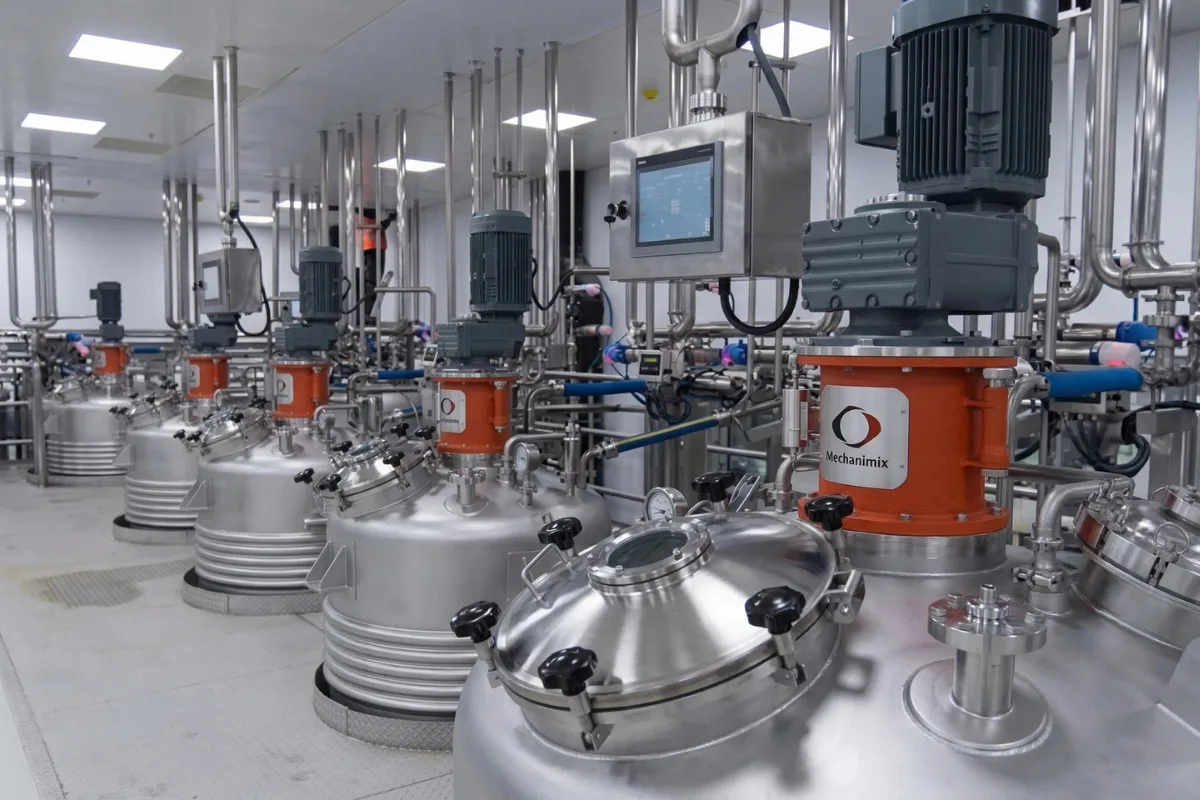
Hygienic process mixer for pharmaceutical production

What Does a Mixer Do in Pharmaceutical Production?

In pharmaceutical production, the mixer dissolves or suspends the active ingredient, evens out concentration and temperature during reaction and crystallization, and homogenizes the phases of viscous formulations. If the duty is defined incorrectly, dose uniformity suffers within the batch, crystal size drifts and contamination risk rises. Mechanimix selects the impeller, sealing and hygienic details for each process duty from process data.

Jacketed reactors, low-shear impellers and feed point design for API reaction and crystallization
Magnetically coupled BED-N with Ra ≤ 0.4 µm electropolished surfaces for sterile liquids
RC-L reactor with PTFE-scraped anchor, optional vacuum and homogenizer for ointments and creams
Hygienic design that takes GMP requirements into account, with CIP/SIP compatible options
PROCESSES

Mixing Duties in Pharmaceutical Processes

The same tank needs a different mixer in a different process. Here is the duty, the main risk and our approach for each one.

API Synthesis Reactions

Agitator duty
Blend reactants and solvent, distribute dosed reagent quickly through the reaction volume, and carry reaction heat to the jacket wall.
Critical risk
If mixing time is longer than reaction time, local over-concentration forms at the dosing point and by-products and impurities increase. Poor heat transfer makes temperature harder to control.
Our solution
HWM or HM impellers in an RC-M jacketed reactor (-28/200°C, -1/+6 bar). The dosing point is placed by the flow field, and mixing time and cooling capacity are checked together.

Catalytic Hydrogenation

Agitator duty
Disperse hydrogen into the liquid, keep solid catalyst suspended and remove reaction heat.
Critical risk
The reaction is often limited by gas-liquid mass transfer. If catalyst settles, reaction time and selectivity change, and hydrogen leakage at the shaft is a safety risk.
Our solution
Self-aspirating GM, sparged GDM, or GDS where solids suspension also matters. The HP Series runs from vacuum to 150 bar, and HPR reaches 250 bar at pilot scale. See Hydrogenation.

API Crystallization

Agitator duty
Keep supersaturation even across the tank, suspend seed and crystals, and spread the effect of cooling or antisolvent through the full volume.
Critical risk
Local supersaturation can cause uncontrolled nucleation and polymorph drift. High tip speed breaks crystals and the fines slow filtration, while weak flow leads to encrustation on the jacket wall.
Our solution
Low-shear HWM-B, or TVM in tall, deep tanks. Speed is set in the range that suspends crystals without breaking them, and antisolvent enters at a high-flow zone. See Crystallization.

Buffer and Media Preparation

Agitator duty
Dissolve salt and media powders without lumps, and even out pH and conductivity across the full volume.
Critical risk
Light powders float and form lumps that are wet outside and dry inside. Incomplete dissolution means a sample no longer represents the tank, and frequent batch changes add to the cleaning load.
Our solution
The bottom-entry BED-N keeps working at low fill levels because the impeller sits at the tank floor. Powder addition point and dissolution time are planned around the batch cycle.

Sterile Liquid Formulation (Injectable and Ophthalmic)

Agitator duty
Keep active and excipient ingredients homogeneous in solution and complete the formulation in a closed system.
Critical risk
The shaft penetration and seal are contamination points. Dead zones make cleaning and sterilization harder, and in protein solutions excess foam and air entrainment can damage the product.
Our solution
Magnetically coupled BED-N: no dynamic seal and no shaft through the headspace. AISI 316L, Ra ≤ 0.4 µm electropolished surfaces and SIP up to 134°C. Low-speed operation limits foaming.

Oral and Coating Suspensions

Agitator duty
Keep active ingredient or pigment particles uniformly suspended throughout filling or spraying.
Critical risk
Settling breaks dose uniformity: the first and last bottles of a fill can hold different amounts of active ingredient. Unnecessarily high speed entrains air and changes the suspension structure.
Our solution
Low-shear axial flow with HWM or HM. Impeller position is chosen so mixing continues as the tank empties. Binder solutions for wet granulation are prepared the same way.

Ointments, Creams and Gels

Agitator duty
Heat and blend viscous phases, emulsify oil and water phases, and renew the product at the wall so heat transfers evenly.
Critical risk
As viscosity rises, a stagnant layer forms at the wall. Heat transfer falls and phase separation and local overheating appear, while entrained air harms stability and fill weight.
Our solution
RC-L reactor: the PTFE-scraped anchor clears the wall, optional vacuum removes air and an optional homogenizer reduces droplet size. HVM is assessed for viscous phases.

Syrups and Oral Solutions

Agitator duty
Dissolve sugar or sweetener and distribute active ingredient and flavor evenly through a viscous solution.
Critical risk
Solid sugar can stay undissolved on the tank floor, and the top zone stops mixing as viscosity climbs. Overheating causes color and flavor drift, and entrained air creates foam.
Our solution
HM or HWM by viscosity, and HVM for heavy syrups. The impeller is placed to sweep the floor, and jacket temperature and dissolution time are calculated together.

API Drying and Blending

Agitator duty
Keep wet filter cake moving under vacuum so heat transfers evenly and the batch stays homogeneous.
Critical risk
Fragile crystals break under mechanical load. Heat-sensitive APIs degrade through local heating at hot surfaces, and solvent vapor is a separate safety item.
Our solution
VD-M with spiral or twin-axis agitator, double-cone VD-R for more delicate products, and VD-P at R&D scale. Selection follows the product's flow and breakage behavior.
SELECTION GUIDE

7 Critical Questions When Selecting a Pharmaceutical Mixer

Clarifying these points before you request a quote leads to the right design and the right price.

CriterionWhy it mattersHow we handle it
Viscosity and flow behaviorA water-like solution and an ointment do not mix with the same impeller. Viscosity changes flow regime, impeller type and power.HWM or HM for low viscosity, HVM above 500 cP, and a scraped anchor for semi-solids. Calculations use the most viscous point of the batch.
Shear sensitivityCrystals, proteins and delicate suspensions are damaged by high tip speed. Emulsions, on the other hand, need a certain amount of shear.The product limit is defined first. Low-shear HWM and HWM-B for sensitive products, and an optional homogenizer for droplet size reduction.
Contamination barrierThe shaft penetration is the most critical point between product and environment. For sterile or toxic products, product risk decides the choice.Magnetically coupled BED-N for sterile liquids, single, double or triple mechanical seals on reactors, and magnetically coupled HP-H or HPR at high pressure.
Cleaning and sterilizationDead zones, impeller connections and the bearing area hold residue. Residue is a cross-contamination risk.Drainage, impeller connection and surface finish are designed together. CIP/SIP compatible options exist for BED-N, RC-L and RP.
Solids contentParticle size, density and solids fraction set the suspension speed. Hard particles can wear a magnetic coupling bearing.Just-suspended speed is calculated as a starting point with the Zwietering correlation. Bearing and sealing choices are checked separately for solids-bearing products.
Batch size and minimum levelPharmaceutical tanks run at different fill levels. An exposed impeller increases foam and air entrainment.Minimum and maximum working levels are defined together. Bottom-entry BED-N is assessed for low fill, and a VFD for variable loads.
Heat transfer and temperature profileCooling ramps in crystallization, heat removal in reactions and phase temperature in creams all decide product quality.Jacket area, impeller and speed are calculated together. RC-M runs at -28/200°C and RC-L at 20–160°C.
ENGINEERING

Details That Matter for Hygiene and Safety

Hygienic Surfaces and Materials

AISI 316L and Ra ≤ 0.4 µm electropolished surfaces on BED-N. Reactor materials are chosen for the chemistry. Our approach is hygienic design that takes GMP requirements into account.

Sealing

Magnetic coupling or single, double and triple cartridge mechanical seals, depending on the process. The choice weighs product risk, pressure and torque together.

Explosive Atmospheres

For solvent-based API processes and hydrogenation, we can design for ATEX and Ex-proof requirements.

Documentation

Documentation scope is clarified at the quotation stage according to project requirements. Share the documents and test steps you expect at the first meeting.

HOW WE WORK

From Process Data to a Running Agitator

  1. Process dataWe define the duty first: fluid or slurry properties, tank geometry, operating conditions and the result you need.
  2. Hydraulic sizingImpeller type, diameter, speed and power are calculated from that duty, not picked from a catalogue.
  3. CFD validationWhere the risk justifies it, flow, dead zones and blend or suspension behaviour are checked before manufacturing.
  4. Mechanical design and deliveryShaft, bearings, seal, materials and drive are designed for the loads; supply, installation support and commissioning follow.

Recommended Equipment for This Sector

The right equipment follows from the process duty. These are the starting points.

Stainless Reactors

RC-M for API synthesis and crystallization, RC-L for creams and ointments, RP for pilot scale and HPR for high pressure.

View details →

BED-N Bottom-Entry Mixer

Magnetically coupled hygienic mixer for buffer, media and sterile liquid tanks from 10 L to 30 m³.

View details →

Vacuum Dryers

VD-M, VD-R and VD-P series for heat-sensitive APIs and intermediates.

View details →
FAQ

Frequently Asked Questions

Which mixer is used in pharmaceutical production?+
The choice depends on the process; there is no single pharmaceutical mixer. Jacketed reactors with HWM or HWM-B lead for API reaction and crystallization, magnetically coupled BED-N for sterile liquids and buffers, and scraped RC-L for ointments and creams. Viscosity, solids content and sterility needs decide the final layout.
Why are magnetically coupled mixers preferred for sterile production?+
Because the shaft does not pass through the vessel wall with a dynamic seal; torque is transferred by a magnetic field. This removes a seal-related leak path and cleaning point. BED-N is bottom-entry, so there is no shaft through the headspace either. Bearing wear is assessed separately for products containing solids.
Which impeller is used for API crystallization?+
Low-shear axial-flow impellers are used; at Mechanimix, HWM-B leads for this duty, with TVM in tall tanks. The goal is to keep crystals suspended without breaking them. Speed, cooling ramp and antisolvent feed point are defined together.
Which mixer is right for ointments and creams?+
Semi-solid products call for a reactor with a wall-scraping anchor. RC-L combines a PTFE-scraped anchor with optional vacuum and homogenizer. HVM is assessed for mixing a viscous phase on its own.
Why does powder form lumps during buffer preparation?+
The outside of the powder wets quickly and forms a skin, leaving the inside dry. The fix is to feed powder at a controlled rate into a high-flow zone. The mixer has to pull powder down from the surface and keep the tank uniform throughout dissolution.
How is settling prevented in oral suspensions?+
With axial flow and the right speed to keep particles suspended throughout filling. HWM or HM impellers are positioned according to tank level. Unnecessarily high speed entrains air, so minimum level and filling time are defined from the start.
Which mixer is used in a hydrogenation reactor?+
Pressure-rated mixers with GM or GDM impellers are used to bring gas into the liquid. GDS is assessed when catalyst suspension also matters. The HP Series runs from vacuum to 150 bar. We can design for ATEX and Ex-proof requirements.
How do you select a mixer for GMP production?+
Selection is driven by product risk and cleanability. We apply hygienic design that takes GMP requirements into account: cleanable surfaces, drainage and sealing suited to the product. Alignment with your site quality system is clarified together at the start of the project.
Do you provide IQ/OQ/PQ and FAT/SAT documents?+
Documentation scope is clarified at the quotation stage according to project requirements. Simply share your expectations with your specification. The quotation defines which documents and tests are included.
What data is needed for a pharmaceutical mixer quote?+
Tank diameter and liquid height, batch size, minimum working level, viscosity, density, solids content, temperature, pressure, solvent details and cleaning method are a sufficient start. We can build assumptions together for any data you do not have.

Tell Us About Your API or Formulation Process

Start with your product properties, batch size and cleaning requirements. We will define the duty and size the right mixer with you.

Get a Quote →